A structural history of the Persian mind
The Liquid
Fortress
Why did Persia survive 3,000 years of invasion when every other ancient civilization died? The architecture of meaning that could not be burned.
Essential reading
All essays →Balochi Orality: The Sound of the Sand
Exploring how the Balochi people maintained the Persian signal through oral poetry in history's most entropic environment.
The Kurdish Shield: Guardians of the Horizon
Analyzing the Kurdish identity as a high-durability defensive shell for the western horizon of the Persian plateau.
Qashqai Weaving: The Fractal Garden
How the Qashqai tribe compressed the geometry of the Persian garden into a portable, fractal format.
The Bakhtiari Migration: The Longest Sync
Analyzing the seasonal migration of the Bakhtiari tribe as a biological synchronization protocol for the Persian plateau.
The Vizier's Protocol: Administrative Resonance
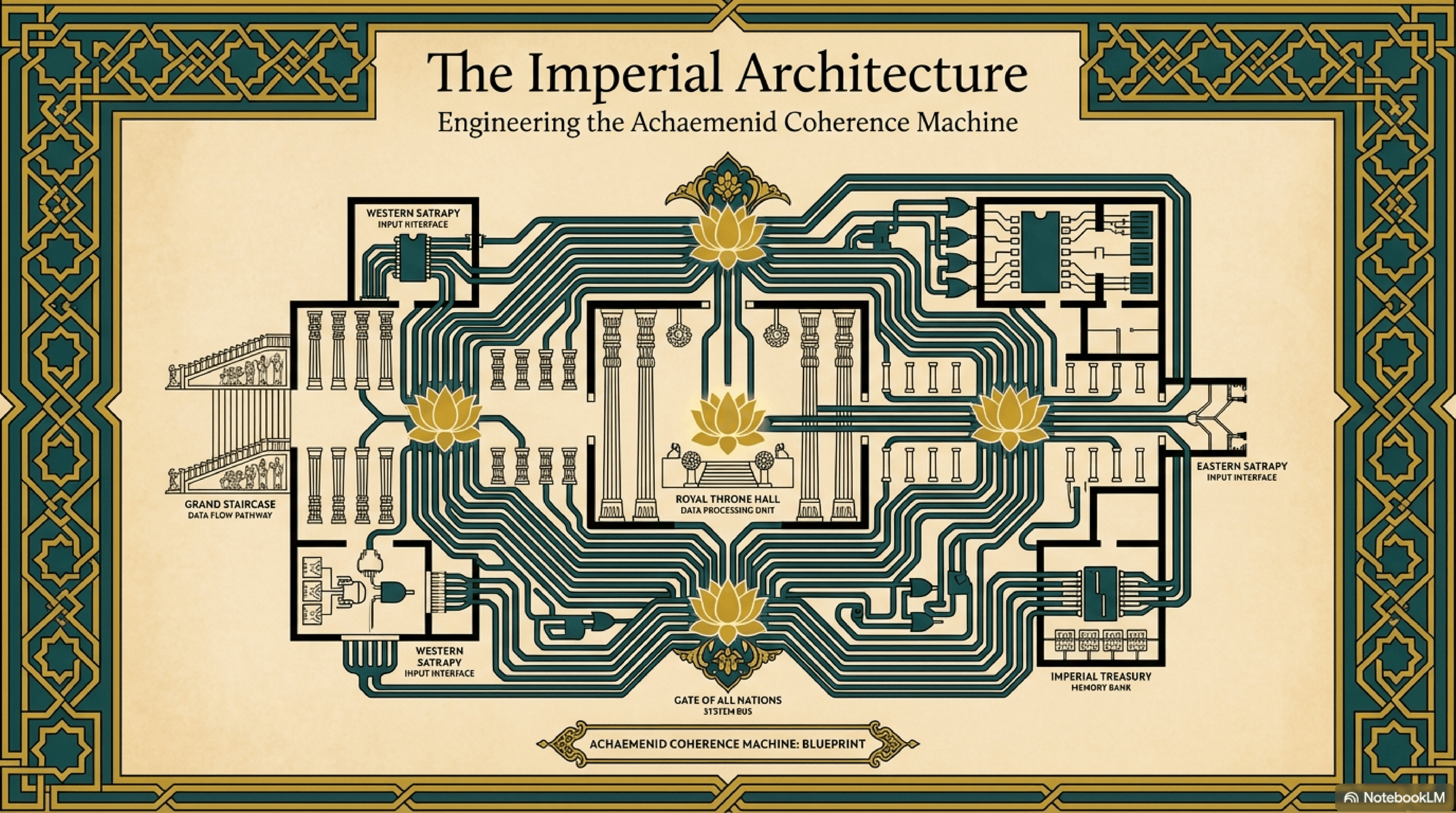
Analyzing the role of Persian Viziers as history's first 'System Administrators' who ran a foreign empire using an ancient logical kernel.
Quarterly Status: The State of the Fortress
Closing the first quarter of the Sovereign OS activation. Auditing the coherence of our digital garden.
The Persian does not build walls to keep enemies out. He builds gardens to keep meaning in.
— The Liquid Fortress
The Seven Heavens · μ-Stack
Seven floors of reality, from Matter to Unity.
A Stone Fortress builds only on μ1 and shatters. The Liquid Fortress keeps resonance across all seven floors — and so it cannot be burned.
- μ7 Sky — Unity & Metaphysics
- μ6 Story — Myth & Narrative
- μ5 Garden — Symbol & Image
- μ4 Map — Reason & Logic
- μ3 Fire — Emotion & Ethics
- μ2 Rhythm — Body & Ritual
- μ1 Roots — State & Matter
The human interface of the stack
The Seven Guardians
All seven, in resonance — the Complete Human, انسان کامل · Insān-i Kāmil.